“My work is to disenchant painting. There is nothing mysterious about my paintings; I have shared all my methods, and anyone can try them. The mystery of art lies not in techniques, but in the wonder that such deeply personal expression can resonate with another human being —‑ that is where the true magic resides.”
— Wang Guangle
On the afternoon of August 9th, the Publicity and Culture Center of Chaoyang District, Beijing, and CAFA Art Museum jointly hosted The Sparse And Dense Timespace: In‑Depth Dialogue Art Education Salon with Artist Wang Guangle at the museum. The exhibition hall was transformed into an open “living room”. More than 50 members of the public and art enthusiasts joined artist Wang Guangle, stepping into the visual realm woven by density and sparsity for a dialogue revolving around materials, time and perception.
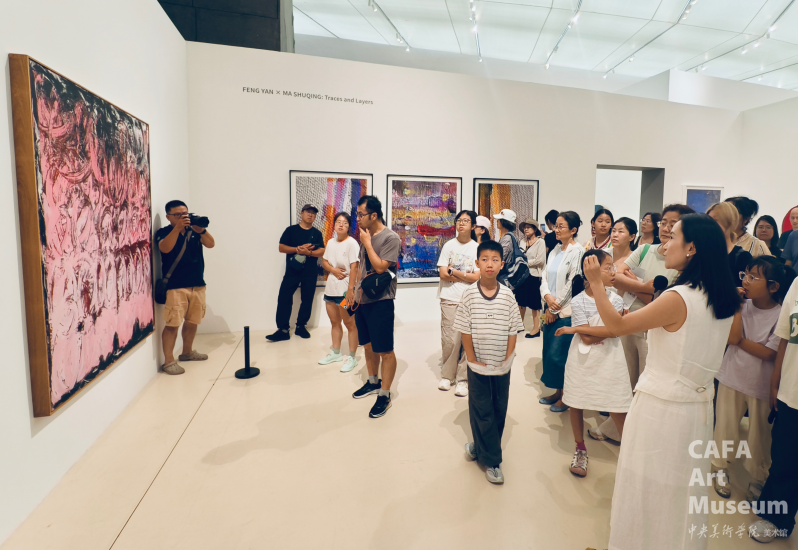
Prior to the art salon, Xiao Baozhen, Director of the Public Education Department of CAFA Art Museum, led the audience through The Sparse And Dense Timespace exhibition. Especially within spaces where works by the three artists engage in pairwise dialogue, she guided participants to observe comparatively from dimensions including color, texture and spatial relations. She then raised a highly relevant contemporary question: given that AI can generate images in an instant, why do we still need to stand before original artworks? The answer gradually unfolded through viewing itself. Only when standing physically in front of an original work can one sense the accumulated thickness of paint layers, the drift of light across the surface, and the genuine relationship formed between the scale of the artwork and the viewer’s own body. The initial hesitation of “not understanding” abstract art dissolved through repeated approaching, comparison and contemplation, turning into curiosity for further observation and active inquiry.
Xiao Bao‑zhen, Director of the Public Education Department of CAFA Art Museum, gives a guided tour for the audience
Within this fluid art‑education salon, artist Wang Guangle walked the audience through each of his exhibited works, sharing the stories, methodologies and inspirations behind their creation. From Afternoon, Terrazzo, Coffin Paint to Untitled, he does not depict time as concrete imagery, but lets time permeate his creative process. The inspiration for Coffin Paint stems from the local custom in his hometown Fujian of repeatedly applying paint to burial coffins. For the Untitled series, each layer of paint is allowed to fully dry before the next is applied, building up the painting surface incrementally like steps. Some works took months to complete, while the longest one spanned two years. Several pieces would often “grow” simultaneously in his studio. Though the rules are set, humidity, dust, paint consistency and manual imperfections remain forever unpredictable. Rational frameworks collide with accidental occurrences, and the artworks gradually take shape amid such tension between “control” and “loss of control”.
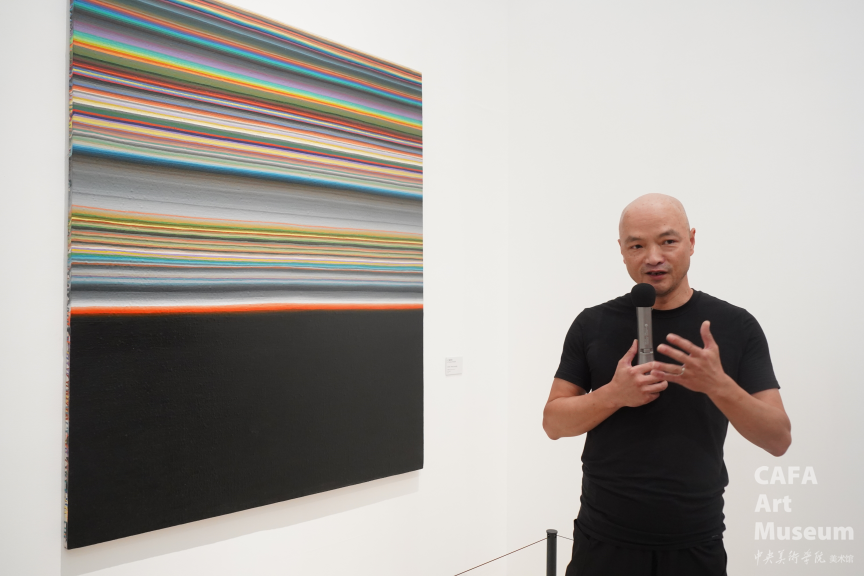
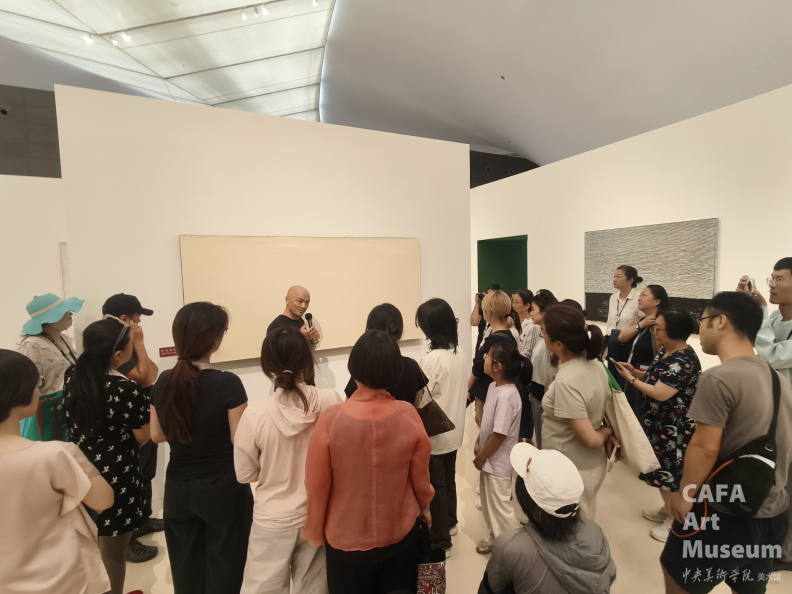
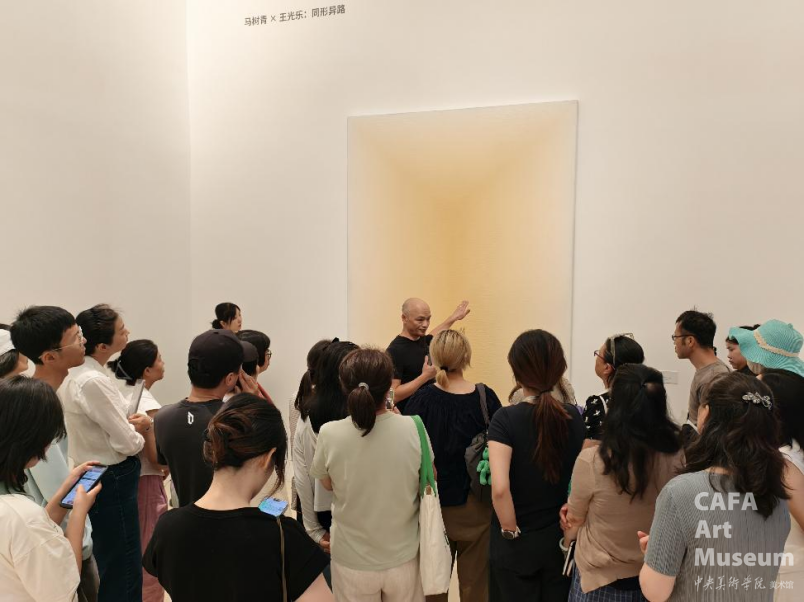
Artist Wang Guangle shares his works with the audience
Standing before a black Untitled work, Wang Guangle invited the audience to observe the brushstrokes up close. After roughly 500 layers of coating, the uncured paint flowed under gravity, with height variations and fine textures taking shape slowly over seven to eight months. Instead of erasing these “accidents”, he preserved the flow traces. Materials are not merely objects to be manipulated, but co‑creators of the artwork. He embraces uncertainties including humidity, dust, paint consistency and manual imperfections, and the work ultimately emerges from the interplay between rational framework and chance occurrences.
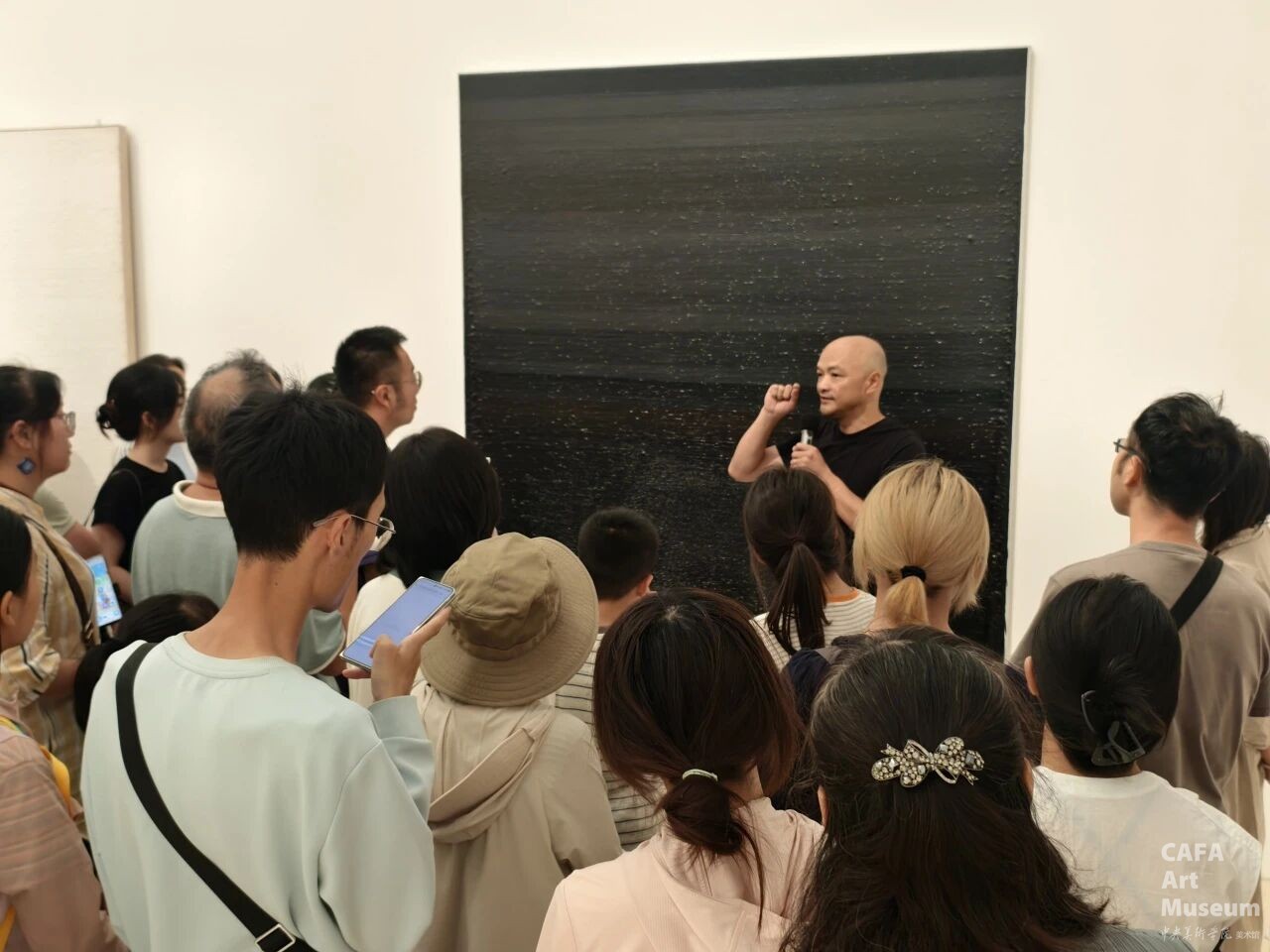
Artist Wang Guangle shares his works with the audience
Questions from the audience unfolded around the artworks: “Do you pre‑conceive the final effect and texture in advance?” “Must abstraction evolve from figuration?” Wang Guangle responded that procedures can be predetermined, yet cracks, grains and flow traces stem from real‑world contingencies. Abstraction and figuration are not entirely separated. His early‑stage realist training enabled him to truly understand paper and paint, though it did not drive him toward a pre‑set “abstract destination”. He simply gradually found a way to express existential perceptions without relying on concrete imagery.
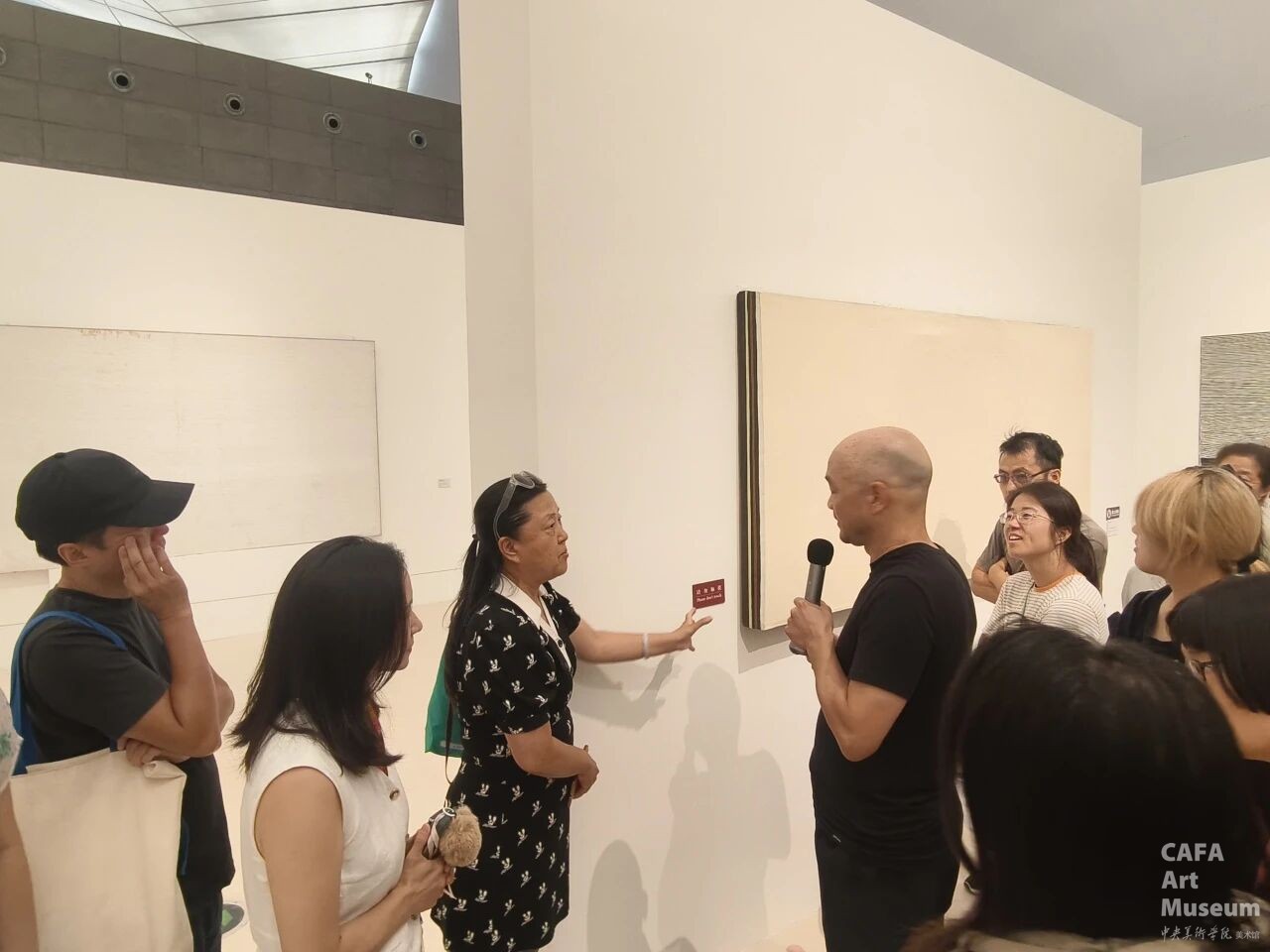
Artist Wang Guangle responds to audience questions
Some perceive hints of “meditation” within his day‑in‑day‑out labor, while other viewers associate his repeated layering brushwork with Gong Xian’s accumulative ink‑washing technique. According to Wang Guangle, repetition never equates to sameness: every brushstroke, period of waiting and polishing takes place in a fresh present moment. The discussion expanded from surface transformations of the paintings to the cultural experiences underlying his creative methodology.
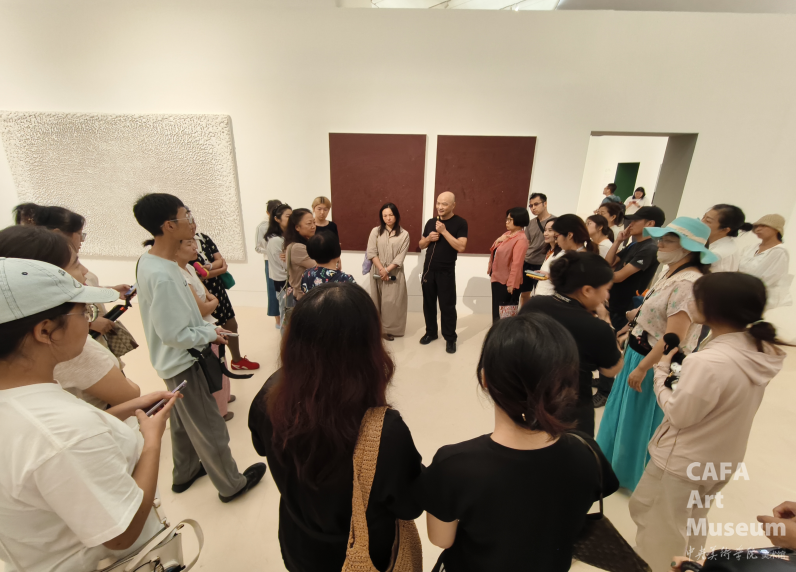
Artist Wang Guangle and Geng Jinghua, Deputy Director of the Public Education Department of CAFA Art Museum,
jointly led the guided tour for the audience
When arriving at Red Phosphorus 251023, a work made of match‑strike strips, the discussion turned to the question: “Who exactly completes an artwork?” Wang Guangle holds that the sparks generated when audiences strike matches across the surface are nothing short of “fleeting flashes of inspiration”. The scratch marks left after the flames die out become part of the work. He wittily compares the artist to a “farmer” who supplies raw ingredients, the curator to a “chef” who arranges the dishes, and audiences taste each “dish” with their own individual experiences. Only when viewing, interpretation and response truly take place can art become a flowing medium between people.
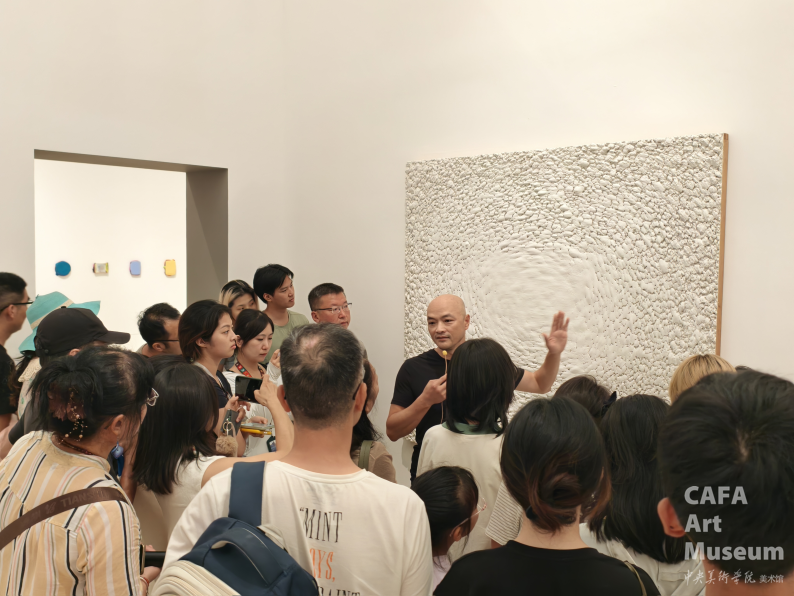
Artist Wang Guangle Shares His Works with the Audience
As the exchange drew to a close, more than 50 audience members shared their viewing experiences through questions and replies with Wang Guangle. The notion of “Sparse And Dense” expanded beyond pictorial rhythm into a mutually‑approaching relationship among the artist, the artworks and the viewers. What participants took away was not a set of standard answers about abstract art, but the possibility of renewed observation and active inquiry. It is within such encounters that social art education comes into being: through the artist’s sharing and public participation, people are inspired to approach artworks and form their own interpretations. We also hope to continuously transform high‑quality art resources into accessible, comprehensible and interactive public‑welfare art‑education services, so that professional art can truly reach the general public.
Editor‑in‑Chief / He Yisha
Responsible Editor / Du Yinzhu
Editor / Liu Ziyue
Text / Zhang Zihan
Photography / Yang Shuhan